Mythological syncretism represents one of humanity’s most fascinating cultural phenomena, where diverse belief systems merge to create entirely new spiritual narratives that transcend their original boundaries.

Throughout human history, civilizations have rarely existed in isolation. Trade routes, conquests, migrations, and diplomatic exchanges have continuously brought different cultures into contact with one another. When these encounters occurred, something remarkable happened: their belief systems didn’t simply clash or replace one another. Instead, they often blended, creating hybrid mythologies that incorporated elements from multiple traditions. This process of mythological syncretism has shaped countless religious and cultural practices that continue to influence billions of people today.
🌍 Understanding the Foundations of Mythological Syncretism
Mythological syncretism occurs when deities, rituals, symbols, and narratives from different cultural traditions merge to form new religious expressions. This fusion isn’t merely a superficial borrowing of ideas but represents a deep integration where separate mythological frameworks interweave to create coherent belief systems that resonate with diverse populations.
The term “syncretism” itself derives from the Greek word “synkretismos,” which originally described the union of Cretan cities against common enemies. Over time, its meaning evolved to encompass the blending of different schools of thought, particularly in religious and philosophical contexts. This evolution of meaning perfectly captures the collaborative nature of mythological fusion, where formerly separate traditions unite to form something greater than their individual parts.
Several factors contribute to mythological syncretism. Political conquest often served as a catalyst, as conquering powers encountered the gods and goddesses of subjugated peoples. Rather than completely eradicating existing beliefs, pragmatic rulers frequently incorporated local deities into their own pantheons, creating hybrid religious systems that facilitated governance and social cohesion.
The Psychology Behind Belief Integration
Human psychology plays a crucial role in enabling mythological syncretism. People naturally seek patterns and connections between seemingly disparate concepts. When confronted with unfamiliar deities or mythological narratives, individuals often identify similarities with their existing beliefs, creating bridges between different traditions. This cognitive process allows for the gradual acceptance and integration of foreign religious elements into established frameworks.
Furthermore, syncretism often serves practical social functions. In multicultural societies, blended mythologies can reduce tension between different groups by creating shared spiritual ground. This common religious language facilitates communication, trade, and peaceful coexistence among diverse populations who might otherwise remain culturally isolated or antagonistic toward one another.
⚡ Historical Examples That Shaped Civilizations
The ancient Mediterranean world provides perhaps the most extensively documented examples of mythological syncretism. The Greco-Roman pantheon itself resulted from the systematic identification of Greek deities with their Roman counterparts. Zeus became Jupiter, Aphrodite transformed into Venus, and Hermes merged with Mercury. This wasn’t simply a matter of translation; each identification brought subtle shifts in attributes, domains, and worship practices.
The Hellenistic period, following Alexander the Great’s conquests, accelerated syncretic processes across three continents. Greek religious concepts fused with Egyptian, Persian, and Indian traditions, creating fascinating hybrid deities. Serapis, for instance, emerged as a deliberately constructed syncretic god combining aspects of the Greek Zeus, the Egyptian Osiris and Apis, and other Mediterranean divine figures. This artificial creation demonstrates how political authorities sometimes consciously engineered religious syncretism to unite diverse populations under common spiritual frameworks.
Egyptian and Greek Divine Marriages
The interaction between Egyptian and Greek mythologies produced particularly rich syncretic traditions. Greek settlers in Egypt identified their goddess Aphrodite with the Egyptian Hathor, both being deities associated with love, beauty, and fertility. Similarly, Thoth, the Egyptian god of wisdom and writing, merged with Hermes to create Hermes Trismegistus, a figure who would profoundly influence Western esoteric traditions for millennia.
These identifications went beyond superficial similarities. Worshippers incorporated Egyptian ritual practices into Greek religious contexts and vice versa. Temple architecture blended Greek and Egyptian styles, while priests developed hybrid theological narratives that explained how these apparently different deities were actually aspects of the same divine forces manifesting across cultures.
🕉️ Eastern Traditions and Syncretic Evolution
Eastern religions have their own rich history of mythological syncretism. Buddhism’s spread from India throughout Asia provides compelling examples of how belief systems adapt and merge with local traditions. As Buddhism traveled along the Silk Road into China, it encountered Taoism and Confucianism, leading to profound mutual influences.
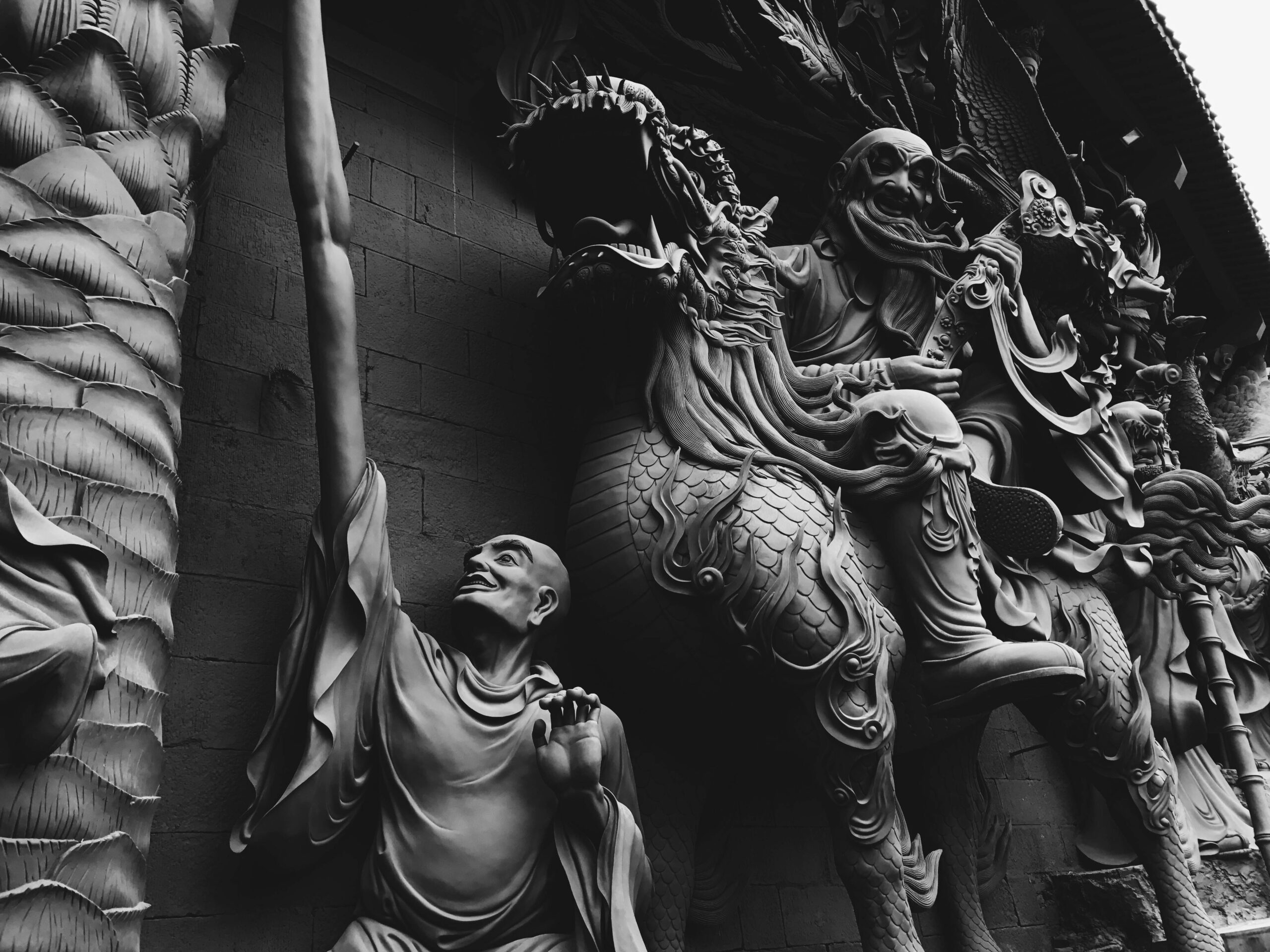
Chinese Buddhism developed distinctive characteristics that differentiated it from Indian Buddhism. Bodhisattvas acquired attributes of Taoist immortals, while Buddhist concepts of karma and reincarnation integrated with Chinese ancestral worship traditions. The popular Chinese deity Guanyin, the Goddess of Mercy, evolved from the Indian bodhisattva Avalokiteshvara, undergoing a gender transformation and acquiring characteristics aligned with Chinese cultural values regarding compassion and motherhood.
Japanese Shinbutsu-shūgō: A Systematic Fusion
Japan developed an exceptionally sophisticated form of religious syncretism called Shinbutsu-shūgō, which systematically combined indigenous Shinto beliefs with imported Buddhism. This wasn’t merely tolerance of different traditions existing side by side; it represented a deliberate theological framework explaining how kami (Shinto deities) and Buddhist figures related to one another.
According to this syncretic worldview, kami were understood as local manifestations of universal Buddhist principles or as beings who themselves required Buddhist enlightenment. Conversely, Buddhist temples often enshrined Shinto kami as protector deities. This remarkable fusion lasted over a thousand years until the Meiji government forcibly separated the traditions in the 19th century, though syncretic practices persist informally today.
🌟 African Diaspora and New World Syncretism
The transatlantic slave trade created conditions for some of history’s most poignant and powerful examples of mythological syncretism. Enslaved Africans, forcibly converted to Christianity yet determined to preserve their ancestral spiritual traditions, developed ingenious syncretic religions that superficially conformed to their oppressors’ faith while maintaining deep connections to African cosmologies.
Santería, developed in Cuba, exemplifies this process. Yoruba orishas (divine spirits) became identified with Catholic saints, creating a double-layered religious system. Practitioners could openly venerate Saint Barbara while actually honoring Changó, the orisha of thunder and lightning, or pray to Our Lady of Charity while connecting with Oshún, goddess of rivers and love. This strategic syncretism allowed enslaved people to maintain spiritual autonomy within systems designed to erase their cultural identities.
Vodou: Complexity Beyond Stereotypes
Haitian Vodou represents another sophisticated syncretic tradition merging West African Vodun, Kongolese spiritual practices, and Catholic elements. The lwa (spirits) of Vodou incorporate African divine archetypes, Indigenous Taíno elements, and Catholic saint imagery. This isn’t superficial borrowing but represents a coherent theological system developed over centuries by communities navigating cultural collision and survival.
Candomblé in Brazil, Vodou in Haiti, and Santería in Cuba share African roots yet developed distinct characteristics reflecting their specific historical contexts and the particular African ethnic groups present in each region. These traditions demonstrate how syncretism can preserve cultural heritage while adapting to radically changed circumstances, maintaining continuity with ancestral wisdom while responding to new realities.
✨ The Mechanics of Mythological Fusion
Several identifiable patterns emerge when examining how different mythologies fuse. Recognition of similar divine archetypes forms the most common starting point. Love goddesses from different cultures naturally correspond with one another, as do storm gods, wisdom deities, and trickster figures. These archetypal similarities provide initial bridges for syncretic identification.
Shared attributes or symbols facilitate these connections. If two deities from different traditions both associate with specific animals, natural phenomena, or human activities, their identification becomes more plausible to practitioners. Visual representations also matter; similar iconography can suggest correspondences between otherwise distinct figures.
Stages of Syncretic Development
Mythological syncretism typically progresses through identifiable stages. Initial contact brings awareness of alternative belief systems. This is followed by a period of comparison, where similarities and differences between traditions become apparent. Next comes selective adoption, where specific appealing elements from the foreign tradition integrate into the receiving culture’s practices.
Eventually, full integration occurs, where borrowed elements become so thoroughly incorporated that their foreign origins may be forgotten or become irrelevant. Finally, new creative synthesis emerges, producing genuinely novel mythological expressions that transcend their source materials. These stages don’t always occur sequentially or completely, and different aspects of belief systems may exist at different syncretic stages simultaneously.
🎭 Contemporary Manifestations and Modern Syncretism
Mythological syncretism didn’t end with ancient civilizations; it continues actively shaping contemporary spiritual landscapes. New religious movements frequently draw from multiple traditions, creating eclectic belief systems that resonate with modern sensibilities. Neo-pagan movements often combine Norse, Celtic, and Greco-Roman elements with contemporary environmental and feminist concerns, producing syncretic practices adapted to 21st-century contexts.
Popular culture has become a surprising venue for mythological fusion. Marvel’s Thor franchise blends Norse mythology with superhero narratives, American cultural values, and science fiction elements, creating a syncretic mythology consumed by global audiences. Similarly, anime and manga regularly fuse Buddhist, Shinto, Christian, and invented mythological elements, generating hybrid spiritual narratives that feel coherent to contemporary viewers despite their eclectic sources.
Digital Age Spirituality and Global Connections
The internet has dramatically accelerated syncretic processes by making diverse mythological traditions instantly accessible worldwide. Online communities dedicated to spiritual exploration freely mix practices from Buddhism, Hinduism, Indigenous traditions, Western occultism, and other sources, creating highly personalized syncretic spiritualities. This “spiritual but not religious” phenomenon represents syncretism at an individual rather than communal level, though online networks provide shared contexts for these eclectic practices.
This democratization of mythological knowledge raises important questions about cultural appropriation versus appreciation. When does syncretic borrowing honor and enrich traditions, and when does it exploit or trivialize them? These ethical considerations have become central to contemporary discussions about religious syncretism in our interconnected world.
📚 Scholarly Perspectives on Mythological Blending
Academic approaches to mythological syncretism have evolved significantly. Early scholars often viewed syncretism negatively, as corruption of supposedly pure original traditions. This perspective reflected colonial and religious biases that privileged certain belief systems as authentic while dismissing others as degraded or primitive.
Contemporary scholarship recognizes that all mythological systems are inherently syncretic to some degree. Pure, isolated traditions represent theoretical constructs rather than historical realities. Even traditions that present themselves as ancient and unchanged have actually absorbed influences from numerous sources over time. This understanding has led to more nuanced analyses of how myths travel, transform, and merge across cultural boundaries.
Comparative mythology, pioneered by scholars like Joseph Campbell, sought universal patterns underlying diverse mythological traditions. While this approach has been criticized for sometimes oversimplifying cultural differences, it highlighted genuine structural similarities that facilitate syncretic processes. Understanding these archetypal patterns helps explain why certain mythological fusions occur readily while others remain improbable.
🔮 The Enduring Significance of Syncretic Traditions
Mythological syncretism matters because it demonstrates humanity’s capacity for cultural dialogue and creative adaptation. Rather than viewing different belief systems as fundamentally incompatible, syncretic processes reveal underlying commonalities and the human imagination’s ability to build bridges across apparent divisions.
These blended traditions also preserve cultural knowledge that might otherwise disappear. When communities face cultural suppression or dramatic change, syncretism can serve as a survival strategy, encoding ancestral wisdom within acceptable forms. The African diaspora religions exemplify how syncretism functions as cultural resistance and preservation simultaneously.
Furthermore, syncretic mythologies often exhibit remarkable vitality and adaptability. By incorporating elements from multiple sources, they develop rich symbolic vocabularies capable of addressing diverse human needs and experiences. This flexibility allows syncretic traditions to remain relevant across changing historical circumstances, continuously regenerating themselves through ongoing cultural exchanges.
🌈 Navigating Multiple Truths in a Pluralistic World
In our increasingly interconnected global civilization, mythological syncretism offers valuable lessons for navigating religious and cultural diversity. Rather than demanding exclusive allegiance to single tradition, syncretic approaches model how different belief systems can coexist, interact, and mutually enrich one another without requiring the elimination of difference.
This doesn’t mean all boundaries should dissolve or that all traditions are interchangeable. Healthy syncretism respects the integrity of source traditions while allowing creative recombination. It acknowledges both commonalities and differences, finding unity without demanding uniformity. This balanced approach proves especially relevant in multicultural societies where people from vastly different backgrounds must find ways to coexist peacefully while maintaining their distinctive identities.
Mythological syncretism ultimately reveals that human spirituality transcends rigid categories. The divine, however conceived, appears remarkably adaptable to different cultural expressions. Gods and goddesses cross borders, merge identities, and speak through multiple voices, suggesting that behind apparent religious divisions lie deeper unities. Whether we interpret this as revealing fundamental truths about reality or simply demonstrating the human mind’s pattern-seeking nature, syncretism reminds us that our spiritual stories connect us more than they divide us, weaving humanity’s diverse cultures into a grand, ongoing mythological conversation.